
Systems
Complete burn-in chambers on our in-house hardware and BIOS software, integrated and shipped to your floor.
- Mini-Mega 1 cf · 5 slots · RBC 5 cf · 8 slots
- PTC 38 cf · 16 slots · Mega 18 cf · 48 slots
- N-Plexer 18 cf · 16 slots, High power RF
High Temperature Operating Life · Since 1978
Mega, Mini-Mega, N-Plexer & RBC – 48, 32, 24, 16, 12, 8, & 5 slot chambers on in-house hardware and software platforms, all engineered and built in Richardson, Texas.
Systems · Boards · Service
Complete burn-in chambers on our in-house hardware and BIOS software, integrated and shipped to your floor.
Custom burn-in boards (BIBs) built for the systems you already own — ours or others'.
We run your parts in our Richardson lab on our own systems and return the qualified data.
Business 01
Complete burn-in chambers — Mini-Mega, RBC, PTC, Mega and N-Plexer — integrated and shipped to your floor.
What Ships
A system is the integration of chambers, power supplies, control computers, interfaces, drivers and burn-in boards with the control software — delivered ready to accept devices. Every configuration is built from one standard hardware and software platform, vertically integrated under one roof.
Mini-Mega (1 cf, 5 slots), PTC (38 cf, 16 slots), Mega (18 cf, 48 slots), N-Plexer (18 cf, 16 slots) and RBC (5 cf, 8 slots) — all on the same in-house hardware, BIOS control software and build floor in Richardson.
1 ft³ chamber with 5 slots for small-lot and early-stage qualification — same in-house hardware, BIOS software and build floor as the larger chambers.
18 ft³ cavity, engineered around the airflow path rather than the other way around. Zone control, per-DUT feedback, +150 °C extended.
Supplies sized to the bias condition, with headroom to 22 kW+ for high-dissipation GaN DC, SiC and high-power logic.
Stimulus, pattern and RF drive delivery to every slot in the cavity.
Custom BIBs designed per spec — BGA/LGA, fine-pitch BGA to 0.3 mm and below, QFN/QFP/DIP and non-standard packages — with real-time heartbeat monitoring.
Proprietary board certification and staging platform: every board proven good before it holds a program hostage.
Sixth-generation TCP/IP controlled automation for real-time monitoring, data acquisition and reporting across thousands of devices, modules and fixtures.
Or skip the capex entirely: send devices to Richardson and we run the burn-in in our accredited lab and return the data.
The Standard Platform
HTOL systems remain the major focus within Delta V. Air flow is horizontal at high velocity to maintain the most consistent temperature performance across every slot in the cavity. Some systems use every other slot to increase BIB (Burn in Board) height constraints — same chamber, same flow path, same control software.
Every slot is individually monitored: per-DUT & per-BIB current, real-time waveforms, and board heartbeat feedback into the BIOS control software, so a device that drifts out of condition is on the record the moment it happens rather than at the end of a 1,000-hour run.
Use the controls to see both populations, with and without the intercooler.
48 slots populated at 175 W per DUT — 8.4 kW into the cavity against a 7.5 kW ceiling @ 125 °C. Full population for maximum throughput per chamber instance. Air cooling only — dissipation carried out by flow velocity alone. Standard flow profile.
Capability Coverage
Burn-in board types, temperature envelopes and specialty capabilities available on the standard Delta V hardware and software stack.
| Capability | Delta V specification | Status |
|---|---|---|
| HTOL — High Temperature Operating Life | +50 °C to +135 °C standard, +150 °C extended | Full |
| GaN DC RF HTOL — RF-biased high power | Liquid-cooled systems to 22 kW, ~500 W per DUT | Market leader |
| PTC — Power Temperature Cycling | −40 °C to +150 °C, per-DUT bias through cycle | Full |
| LTOL — Low Temperature Operating Life | −40 °C to +150 °C | Full |
| THB — Temperature Humidity Bias | 85 °C / 85 % RH | Full |
| Wafer Level Burn-In (WLBI) | US-patented Delta V wafer level burn-in system | Patented |
| SiC power device HTOL | Packaged-part HTOL for EV and industrial power | Full |
| HAST — Highly Accelerated Stress Test | Compression-mount, high-density boards | Supplier |
| System Level Test (SLT) | Module and fixture level test integration | Supplier |
Specialty Engineering
RF-biased high-power operating life on a closed-loop liquid platform. A 22 kW liquid-cooled GaN DC RF HTOL system shipped to a major defense contractor in December 2024 — no other burn-in board house prominently offers this class of system.
Frequency-domain monitoring while the device is under bias and at temperature, with RF HTOL platforms extending to 35 GHz for AESA radar, electronic warfare, 5G mmWave and satellite payload components.
Per-DUT temperature control with closed-loop feedback and individual current monitoring, so a 500 W RF part and its neighbour both sit at their intended junction condition instead of an average.
Delta V holds a US patent on its wafer level burn-in system — full-wafer stress before singulation, in-house and under the same control software as packaged-part burn-in. Both wafer-level and packaged-part burn-in run on one platform.
The BOSS certification system and Stager platform verify every burn-in board before it enters production — continuity, socket integrity and channel response, documented per serial number. No competitor ships an equivalent.
Six generations of in-house burn-in operating software: TCP/IP networked control, GUI test programming, serial-number tracking and enterprise database reporting across thousands of devices.
Thermal Architecture
Air travels side to side across the boards at high velocity. Uniformity across 48 slots is governed by velocity and flow path, not by cabinet size — so the path is designed first and the chamber is built around it. The load's own dissipation is carried out of the cavity instead of stratifying inside it, which is what holds temperature consistent from the first slot to the last.
An internal liquid heat exchanger, fed from an external chilled glycol loop, acts as an intercooler for the chamber environment. It carries dissipation past the ceiling of air alone, and pulls ambient down when the junction-to-ambient differential is large — the same architecture behind our liquid-cooled 22 kW high-power GaN DC RF systems.
Production Volume
Many systems have been scaled up in multiple instances to provide large production volumes. Scaling adds chambers — it does not add a second platform to qualify, a second software stack to learn, or a second correlation exercise to run. The instance count changes. Nothing else does.
Burn-in is calendar time. Capacity is the only lever.
Protected Technology
Delta V holds a granted United States patent on the wafer level burn-in system — filed 2017, granted 2019, in force to 2037. It is the architectural backbone of our wafer-level product line.View the patent (PDF) →
Claim Coverage
Six protected elements, drawn from the granted claims of US 10,267,845 B2 and the broader 24-claim published application in the same family.
Upper and lower platen assemblies circulate a liquid heat-exchange medium above and below the wafer, so temperature is driven from both wafer surfaces at once. No competing wafer-level burn-in patent claims two-sided liquid thermal management.
An interposer establishes one-to-one electrical connectivity between every die on the uncut wafer and its own dedicated current amplifier — individual bias and individual current measurement across the whole wafer.
A teleconcentric two-camera system registers the pin chuck to the wafer before contact, then a wafer support structure raises and lowers the wafer against the chuck with repeatable planarity.
When a die exceeds its programmed parametric limits, that die alone is powered down. A single runaway device cannot corrupt the stress conditions or the data for the rest of the wafer.
An onboard CPU and controller monitor programmable parametric limits continuously while the wafer is energised — burn-in and functional test happening simultaneously rather than as two separate insertions.
The claimed method energises, burns in and tests every die on an uncut wafer at the same time — the yield and cost argument for wafer-level burn-in, protected as a system and as a method.
Why It Matters to You
Infant-mortality failures are removed at the wafer, so packaging, substrate and assembly cost is not spent on die that were never going to survive burn-in.
Two-sided liquid platens are what make high-dissipation SiC and GaN DC die practical at wafer level, where single-sided air or chuck-only cooling runs out of headroom.
Per-die amplifiers and per-die shutdown produce individual current and parametric history — the traceable evidence defense, space and automotive qualification packages ask for.
The same in-house BIOS control software that runs our packaged-part HTOL, PTC, LTOL and THB systems drives the patented wafer-level platform. Both wafer-level and packaged-part burn-in run on one platform, so correlation between stages is ours to prove.
IP Landscape
Publicly granted wafer-level burn-in patents, by approach. The foundational cartridge and compliant-membrane filings have expired; the thermal and per-die control architecture we practise is ours and current.
| Holder / approach | Filings | Status | What it claims |
|---|---|---|---|
| Delta V Instruments | US 10,267,845 B2 · US 2018/0328978 A1 | Active to 2037 | Liquid-cooled dual-platen wafer level burn-in, 1:1 per-die current amplifiers, teleconcentric camera alignment, per-die shutdown. |
| Wafer-level cartridge specialist | US 6,340,895 B1 · US 6,580,283 B1 | Expired 2019 | The foundational chuck-plate-plus-probe-plate cartridge patents. Now prior art — their expiry is what opened wafer-level burn-in to new architectures. |
| Wafer-level cartridge specialist | US 10,401,385 B2 · US 11,448,695 B2 | Active | Pneumatic contact-force control and a cartridge-based system frame. A different answer to contact repeatability than our camera-registered pin chuck and interposer. |
| Compliant-membrane pioneer | US 5,886,535 A (92 claims) | Expired 2016 | ePTFE compliant Z-axis interconnect for planar wafer contact. Never commercialised; expiry moved the whole approach into the public domain. |
| ATE platform vendor | US 7,872,482 B2 | Active | High-density probe interconnect for wafer contact — the electrical interface layer, not thermal management or per-die bias control. |
| IDM design-in approach | Independently controllable voltage islands | Expired | Wafer-level screening enabled by redesigning the chip itself. Equipment-based approaches won because customers will not respin silicon for testability. |
| Board-only burn-in manufacturers | No active wafer-level system patents identified | — | Scale and customer relationships rather than protected wafer-level architecture. Public patent searches return only expired die-carrier filings. |
Patent status compiled from public USPTO and European Patent Office records, current as of May 2026. Informational summary — not a legal opinion or freedom-to-operate analysis.
Business 02
Custom BIBs built for the systems you already own, ours or others'.
Burn-In Boards
Boards are designed, built, tested and delivered to customer specification for use in existing customer-owned burn-in systems — ours or others'. As new devices are designed, a new burn-in board is required for evaluation testing, so this is a constant flow of custom work. Delta V has completed hundreds of burn-in board designs, producing thousands of boards for over 30 semiconductor manufacturing companies.
Socket, retention, thermal interface and channel routing worked to the package and the stress condition.
Every board is proven good on our proprietary BOSS & Stager platform before it holds a program hostage.
Real-time board heartbeat feedback into BIOS so a failing board is caught at the slot, not at the end of the run.
Sockets & Packages
BIBs are designed per device, not selected from a catalogue. Socket selection, retention, thermal interface and channel routing are worked to the package and the stress condition.
Business 03
We run your parts in our Richardson accredited lab and return the data.
Turnkey Burn-In Service
Ship devices to Richardson and we run the burn-in on our own systems, in our own lab, with our own engineers — then return the parts and the qualified data.
Work is run in our ISO/IEC 17025:2017 accredited, ITAR registered lab in Richardson, Texas.
Systems and boards already on our floor, so programs start on calendar time, not procurement time — no capex, no headcount, no idle asset between programs.
US-owned and US-manufactured with no subcontracted test steps — trusted on U.S. Army Programs, U.S. Navy Programs and prime-contractor work.
Two Ways to Run It
Arrives integrated and ready to accept devices — chamber, power, drivers, boards and BIOS control software, installed and correlated at your site, scalable to as many instances as your volume needs.
In many cases the system remains within Delta V and we run the work as complete turnkey burn-in service from our ISO/IEC 17025 accredited lab. No capital outlay, no headcount, no idle asset between programs — you receive the qualified data.
Why This Matters On Government Programs
A conventional burn-in program threads through five to eight organizations, each with its own schedule, its own change-control queue and its own export posture. Working with a vertically integrated supplier collapses that chain to one.
Outsourced program path
Every arrow is a schedule risk and a compliance question.
Delta V program path
Mechanical, hardware, firmware, FPGA, middleware, UI, manufacturing, accredited test and lifetime support. One entity, one site, US-owned, ITAR registered.
Not third parties, not job-shops, not external contractors. Every discipline on the program is a Delta V employee on a Delta V badge.
Design, fabrication, assembly, software, firmware, FPGA and final test all happen inside our Richardson, Texas plant.
A single US-owned entity in a single US location keeps the technical data package where it belongs and simplifies your compliance narrative.
Configuration control, calibration records and as-built documentation come from one system of record, not five vendors' spreadsheets.
A test-flow change touching UI, middleware, firmware and FPGA is a hallway conversation between four engineers who report into the same building.
The people who wrote the RTL and the C# screens are still here in year ten to spin a board or patch a driver.
Credentials & Documents
Delta V carries the following accreditations:
Delta V holds the following patent and is registered with ITAR.
Why Delta V
Track record, competitive position and a straight answer on fit.
About Delta V
Reliability test and burn-in technology, engineered and built under one roof in Richardson, Texas — since 1978.
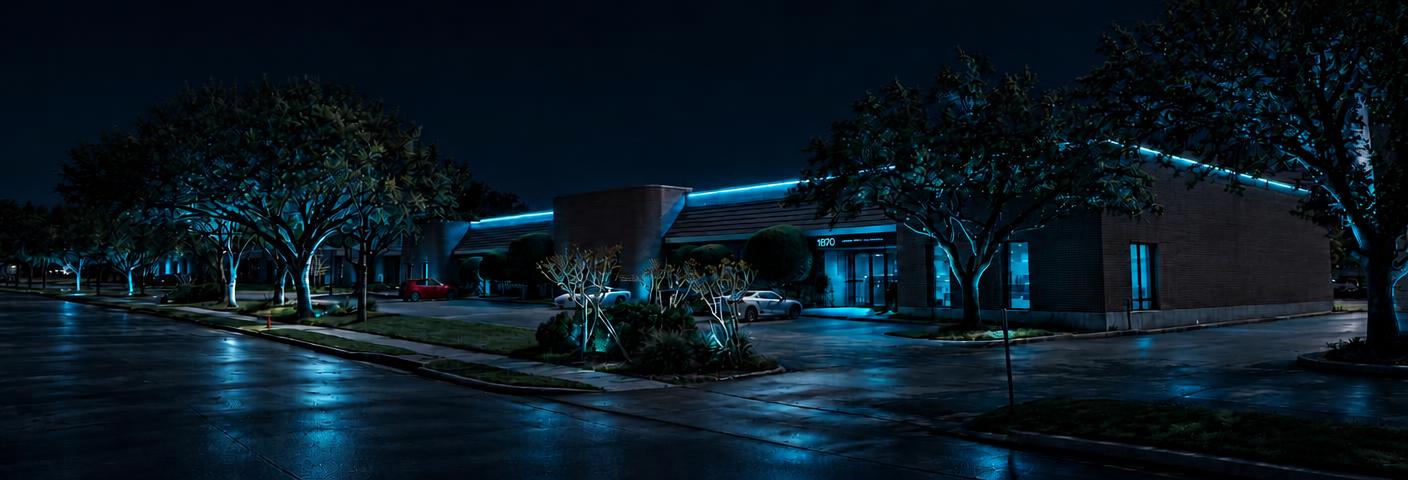
Forty-seven years of burn-in engineering — family owned, US owned, and still led by the people who built the platform.
Every chamber, board and line of firmware is designed, built and supported at our single Texas facility. No subcontractors, no handoffs.
ITAR registered with the US Department of State, with an ISO/IEC 17025:2017 accredited lab in-house.
1870 Firman Drive, Richardson, TX 75081 · 972-644-6501
Competitive Position
The burn-in market splits into global board manufacturers, European board houses, diversified test conglomerates and wafer-level equipment specialists. Each is strong somewhere. Here is where the overlap ends.
| Capability | Delta V | Global BIB houses | European BIB houses | Diversified test groups | Wafer-level specialists |
|---|---|---|---|---|---|
| Custom burn-in boards, all system typesTable stakes — every serious vendor builds boards. | Yes | Yes | Yes | Yes | No |
| RF-biased GaN DC HTOL, liquid-cooled to 22 kWBoard houses stop at air-cooled DC bias; RF instrument vendors sell channels, not turnkey chambers. | Yes | No | No | No | Partial |
| ~500 W dissipated per DUT positionNeeded for GaN DC amplifiers, SiC modules and high-power defense RF devices. | Yes | Partial | Partial | Partial | Partial |
| 700 MHz – 8.4 GHz per-DUT RF monitoring (35 GHz roadmap)Wideband in-situ RF measurement inside the chamber, not on a bench afterwards. | Yes | No | No | Partial | No |
| ISO/IEC 17025:2017 accredited lab in-houseAccredited data, not just accredited paperwork on the build. | Yes | No | No | Partial | No |
| US-owned, ITAR registered, single-site Texas buildMatters for defense, space and controlled-technology programs. | Yes | No | No | Partial | No |
| Patented wafer level burn-inWe hold a US patent; wafer-level specialists compete here with capital equipment. | Yes | Partial | No | No | Yes |
| Own burn-in control software, 6 generations deepBIOS is ours — driver work and custom patterns are an engineering ticket, not a roadmap request. | Yes | Partial | Partial | Yes | Yes |
| BOSS board certification before shipmentEvery board electrically certified against its own test program. | Yes | Partial | Yes | Yes | No |
| Boards, chambers, software and services from one vendorOne accountable owner when a qual lot is on the line. | Yes | Partial | Partial | Partial | No |
| Direct access to the engineers who designed itNo account-management layer between you and the designer. | Yes | No | Partial | No | Partial |
| Scale by adding chamber instances, not duplicating bench equipmentTurnkey platform scales with repeatability; homegrown benches scale by rebuilding the bench. | Yes | No | No | Partial | No |
● Standard capability◐ Varies by vendor or program○ Not offered
Category assessment based on publicly published product literature and specifications from vendors in the burn-in board and burn-in system market. Capabilities differ between individual suppliers within each category.
Why Programs Choose Delta V
The global board houses build superb DC burn-in boards and the RF instrument makers build superb RF channels. Almost nobody delivers a liquid-cooled, RF-biased chamber that does both at 22 kW. That is the specific gap the Delta V platform was built into — and a 22 kW GaN DC RF HTOL system shipped to a major defense contractor in December 2024.
Competitors are either equipment suppliers or test-service labs. Delta V is ISO 9001:2015 certified and ISO/IEC 17025:2017 accredited, so the same team that designs the board can also run the qual and hand you accredited data — without a second supplier qualification cycle.
Much of the BIB market is served from Singapore, Malaysia, China, Taiwan, Ireland and Japan. Delta V is American owned, ITAR registered and built in Richardson, Texas, with a track record on U.S. Army Programs, U.S. Navy Programs, Raytheon / RTX, BAE Systems and Collins Aerospace programs.
BIOS is in its sixth generation and written in-house. Custom bias sequences, per-DUT polling, new device drivers and data formats are scoped by the engineers who own the source. Source is never distributed or released to clients — it stays inside Delta V.
Forty-eight years, 30+ semiconductor manufacturers served, and a flat organisation. You get the responsiveness of a specialist with the process discipline of a company that has been auditable since the 1970s.
Design, fabrication oversight, certification and support happen in one Texas facility. Nothing about your device design, test program or schedule crosses a border to get built.
Qualification Standards
Credentials
The Field
Six vendor archetypes quote burn-in work. Each is credible in its own lane. This is an honest read of their strength and the boundary of it.
Singapore · Malaysia · China · Taiwan · Texas
Where they are strong
Largest installed base and broadest ATE load-board compatibility. Genuinely global supply chain support.
Where Delta V wins
No liquid-cooled RF-biased HTOL, no accredited in-house reliability lab, and offshore manufacturing that does not clear ITAR-controlled programs.
Ireland · continental Europe
Where they are strong
Deep automotive semiconductor relationships and dedicated BIB test equipment; strong environmental certification.
Where Delta V wins
Air-cooled DC bias only. High-power GaN DC RF, 500 W-per-DUT dissipation and US defense programs sit outside their platform.
USA · Singapore · Malaysia · Thailand · China
Where they are strong
Thousands of board designs, automated board handling, very high channel-count board testers, public-company scale.
Where Delta V wins
Burn-in is one division among many. Custom RF and defense work competes internally for engineering attention; we do nothing else.
California · global
Where they are strong
Multi-wafer wafer-level burn-in at scale, strong SiC momentum, fully automated cells.
Where Delta V wins
They are capital equipment for wafer-level flows. Packaged-part HTOL, PTC, THB and RF-biased burn-in are not their platform — and we hold a US WLBI patent of our own.
Japan · USA · Europe · Asia
Where they are strong
Enormous R&D, full test ecosystems, cloud analytics, deep IDM relationships.
Where Delta V wins
Their boards are interface hardware for their own testers. Nobody there will design a one-off 22 kW liquid-cooled GaN DC chamber for your program.
California · Taiwan
Where they are strong
Excellent RF-biased accelerated life test channels and reliability software; respected in GaN DC research.
Where Delta V wins
Channel counts suited to characterisation, not production screening. We put RF bias inside a 48-slot production chamber with the boards to fill it.
Vendor Evaluation
Use this list on us and on anyone else you are quoting. The answers separate a board supplier from a reliability partner.
Yes — 700 MHz to 8.4 GHz per-DUT today, with a path to 35 GHz. Ask any board-only vendor this first.
Roughly 500 W per DUT. System-level max is 7.5 kW air-cooled @ 125 °C, or 22 kW with the liquid intercooler engaged.
We do. BIOS is sixth generation and modified in-house on program timelines.
Yes — BOSS certification runs every board against its own test program before it leaves Richardson.
Yes — ISO/IEC 17025:2017 accredited lab, turnkey or on your floor.
Richardson, Texas. American owned and ITAR registered.
Yes — Delta V holds a US patent on wafer level burn-in, and the same BIOS software controls packaged-part fixtures. Both the wafer-level system and the packaged-part chamber family run on one platform, so a single program can move from wafer to package without switching software or correlation.
Per-DUT current monitoring and heartbeat feedback isolate faults in real time, so one failure does not take an entire board or chamber offline.
Engineered horizontal high-velocity airflow and per-DUT feedback keep the cavity uniform rather than relying on cabinet size alone.
Yes — add chamber instances using the same hardware, software and correlation. Volume scales by instance count, not by qualifying a second ecosystem.
Our engineers design the BIB, socket, retention and thermal path per device — BGA, LGA, QFN, RF flange and custom packages included.
Since 1978: U.S. Army Programs, U.S. Navy Programs, Raytheon / RTX, BAE Systems, Collins Aerospace, Motorola/NXP and major GaN DC RF suppliers — including a 22 kW GaN DC RF HTOL system delivered in December 2024.
Straight Answer
We would rather lose a bid than take a program we are not the right shop for. Find your situation below.
Talk to us. Liquid-cooled to 22 kW, ~500 W per DUT, in-situ RF monitoring — this is the platform's reason for existing.
Talk to us. American owned, ITAR registered, single-site Texas build, with U.S. Army Programs, U.S. Navy Programs, Raytheon / RTX, BAE Systems and Collins Aerospace history.
Talk to us. ISO 9001:2015 certified and ISO/IEC 17025:2017 accredited, so one vendor covers hardware and accredited results.
Talk to us. BIOS is ours through six generations, so bias sequencing and drivers are engineering work, not a feature request.
Not our lane. Vector and ATE systems are a different equipment category; we build production burn-in chambers and the boards that run inside them.
A global board house with local depots will serve that logistics footprint better than we will. We will say so.
If you need a multi-wafer production cell, buy the dedicated platform. Our WLBI patent suits program-specific wafer-level work.
Vertically Integrated
Most burn-in systems are an assembly of other companies' work: a bought control stack, an outsourced FPGA, a contract mechanical shop, an offshore board house. Ours is not. Every layer of the stack below is designed, written, built and supported by Delta V employees inside our Richardson, Texas facility.
6th-generation operator interface — recipes, slot maps, alarm handling, data export. Written, tested and supported by our own software team.
Deterministic scheduling, instrument abstraction, measurement pipelines and datalogging. No licensed third-party control stack we cannot change.
Slot controllers, power sequencing, thermal loops and safety interlocks. Source is owned in-house and retained at Delta V — never distributed to clients — so a program-specific change is a sprint, not a vendor negotiation.
Pattern generation, per-slot timing, RF gating and fault capture live in FPGA fabric we design ourselves — down to the VHDL RTL.
Analog, power and RF board design plus custom burn-in boards with BOSS board certification, all engineered and built on site.
Chamber structure, plenums, liquid-cooling loops and cabling are fabricated and assembled in Richardson, not kitted from an integrator.
Accredited lab characterization, factory acceptance and lifetime support from the same engineers who designed the layer above.
One team, one badge, one building — from RTL in the FPGA fabric to the button an operator presses at 3 a.m.
Scale Without Cloning the Bench
Most customers start with homegrown test benches — racks of general-purpose instruments, HP/Keysight road systems and manually wired one-off setups. When volume grows, the only option is to duplicate the bench again and again. Our platforms replace that sprawl with repeatable, instance-scalable burn-in systems.
Homegrown bench path
Every capacity increase duplicates cost, floor space and calibration burden.
Delta V scalable path
We have replaced homegrown benches at customer after customer once their internal systems hit the ceiling.
Whether you need one 48-slot chamber or a fleet of liquid-cooled RF HTOL systems, the same hardware, software and correlation scales with you — without rebuilding the bench every time.
Market Signals
Every trend reshaping burn-in right now — RF power, high-power thermals, SiC volume, onshoring — points at capabilities already shipping in Richardson.
Shipped to a major U.S. defense contractor — the class of system no other burn-in board house publishes.
Repeat RF-biased burn-in awards as GaN DC moves from research into fielded radar and satcom hardware.
Per-device dissipation on GaN DC and SiC parts is now the binding constraint on burn-in — exactly what the intercooler architecture solves.
Power-device burn-in demand grew across automotive supply chains. Our −40 °C to +150 °C PTC envelope with per-DUT bias covers packaged SiC parts.
Defense and space primes are tightening controlled-technology sourcing. Richardson-built, US-owned, ITAR-registered is now a specification, not a preference.
Extending per-DUT in-situ RF measurement from 8.4 GHz toward 35 GHz for Ka-band and mmWave device programs.
Markets We Serve
HTOL sits alongside our RF HTOL systems, liquid-cooled high-power platforms, custom burn-in circuit boards, wafer level burn-in and TCP/IP control software — one vendor across the qualification flow.
Track Record
Delta V was founded in 1978 to build customized test hardware for Texas Instruments and Motorola. Those relationships never ended — they turned into four decades of burn-in boards, systems and turnkey programs for more than 30 semiconductor manufacturers and the defense primes that depend on them.
Recent Programs
22 kW liquid-cooled GaN DC RF HTOL system delivered to a major U.S. defense contractor — the highest-power RF burn-in platform we have shipped.
Turnkey HTOL services brought online for a new GaN DC amplifier manufacturer, running in our Richardson lab under ISO/IEC 17025 accreditation.
New-generation TCP/IP networked systems with sixth-generation BIOS control software, serial-number tracking and enterprise reporting.
Patented wafer level burn-in and BOSS board certification maintained in-house as part of the standard platform.
Who You Work With
Common Questions
HTOL runs +50 °C to +135 °C standard, with extended operation to +150 °C. The same platform also covers LTOL and power-temperature cycling from −40 °C to +150 °C, and THB at 85 °C / 85 % RH.
Systems have been delivered above 22 kW total, liquid-cooled, at up to roughly 500 W per DUT for high-power RF devices — including a 22 kW liquid-cooled GaN DC RF HTOL system shipped to a major defense contractor in December 2024.
Yes. RF-biased HTOL with wideband monitoring from 700 MHz to 8.4 GHz is our core specialty, with RF HTOL platforms extending to 35 GHz for radar, EW and mmWave programs. GaN DC-on-SiC power amplifiers and SiC power devices are routine work here.
Both. Many systems stay in Richardson, Texas and we run the program as complete turnkey burn-in service out of our ISO/IEC 17025:2017 accredited lab — you receive legally defensible qualification data with no capital outlay.
Delta V is ITAR registered, ISO 9001:2015 certified, American owned and US-manufactured. We have supported the U.S. Army Programs, U.S. Navy Programs, Raytheon / RTX, BAE Systems and Collins Aerospace.
Every BIB is custom designed to the device and the socket, verified on our proprietary BOSS board certification system before it ever sees a chamber, and monitored in service with real-time per-DUT current and heartbeat feedback.